

Air compressors
Air compressors are incredibly versatile. They generate compressed air with pinpoint accuracy, a level of precision that cannot be achieved with conventional power tools. This short guide explains how air compressors work, provides guidance on purchasing criteria, and offers a comprehensive overview of this fascinating topic.
How does a compressor work?
Most compressors used by tradespeople are piston compressors. This principle is easy to explain. A motor drives the piston, which moves inside the cylinder. The piston draws in ambient air and then compresses it. The compressed air is stored in a tank. When needed, a valve on the tank allows for the precise release of the compressed air. Almost all compressors have an automatic shut-off feature that activates once the maximum air pressure is reached. A safety valve prevents the pressure in the tank from becoming too high. The motor restarts as soon as the pressure in the tank drops below a certain level.
Which air compressor is suitable for which application?
Different compressors are required depending on the needs and intended use. Therefore, this should always be considered before purchasing. Many people will only need a compressor for occasionally checking and topping up tire pressure, while others will require a compressor for continuous professional use.
For occasional use, small compressors without an air tank are often perfectly adequate. However, for using pneumatic tools and for painting, a larger unit is recommended. Generally, air compressors with a capacity of 20-50 liters are the appropriate size for these purposes.
How much pressure does a compressor need?
The maximum achievable air pressure is specified in bar and, along with the tank capacity, is crucial for determining the compressor's usability. A helpful rule of thumb here is: the heavier the task, the higher the required air pressure. However, the required air pressure is always specified for each pneumatic tool. This ensures you'll find the right tool for your individual needs.
Maintenance of an air compressor
Condensate is produced during the production of compressed air. It is contaminated by particles contained in the intake air and should therefore be drained regularly. This will extend the compressor's lifespan and ensure smooth operation. The condensate must be disposed of exclusively as hazardous waste, as it contains pollutants that do not belong in household waste. All filters in the compressor should also be cleaned occasionally or replaced if necessary.
Important: Always open the valve carefully to avoid splashing!
WALTER Air Compressor Accessory Set
With the WALTER compressed air accessory set, you'll find the right tools for almost any application – perfect for your compressed air needs.
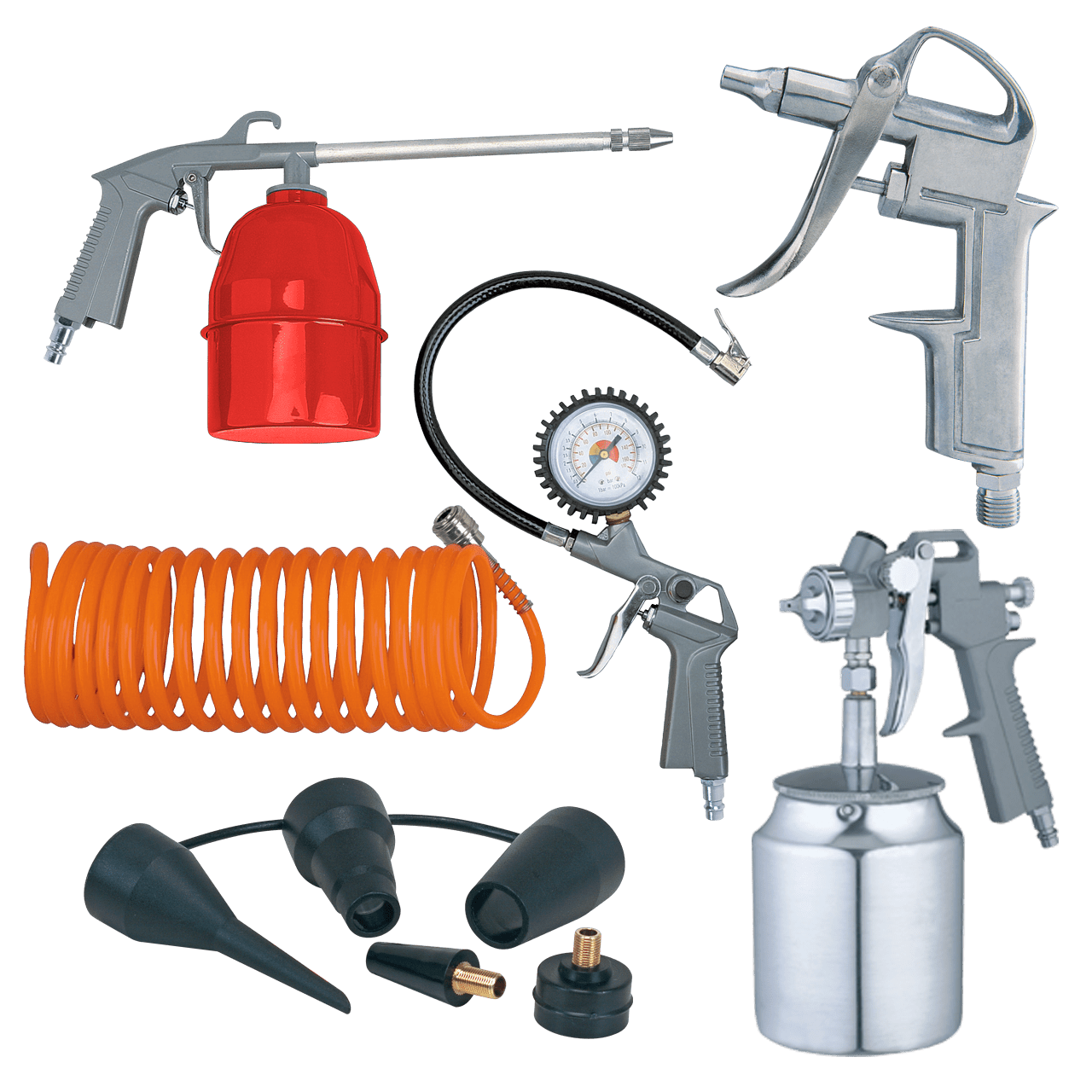
Compressor accessory set 6-piece
The WALTER compressor accessory set for 24 l compressors (item no. K650024, 650017) includes a paint spray gun, inflation gun, tire inflator with pressure gauge, spiral hose (5 m) and adapter – ideal for versatile compressed air work.
This accessory set consists of the following components:

The compressed air spiral hose, with a total length of five meters, ensures that flexible working is made possible with ease.

The tire inflator features a pressure gauge, making it incredibly easy to check tire pressure. It includes a practical universal valve and three additional adapters that can be attached to the clamp valve using the included adapter. This makes the tire inflator versatile and an absolute must-have.

The blow gun is perfect for all blowing jobs. It effectively combats dust and dirt.

The spray gun with suction cup can be used in various applications, including automotive, agricultural, and private use. The spray intensity and material flow can be adjusted at the nozzle, and air consumption can be regulated by pulling the trigger more or less forcefully. The suction cup has a one-liter capacity, allowing for uninterrupted work without the need for constant refilling.

The paint sprayer, combined with the aluminum suction cup, offers the ideal set for applying paint. We recommend a working distance of 15-25 cm to ensure optimal results. The spray pattern can be adjusted using the regulating screw, and the amount of paint dispensed can be controlled with the paint flow regulator screw.